Warfare in Medieval Europe 400-1453 by Bernard S Bachrach & David Bachrach
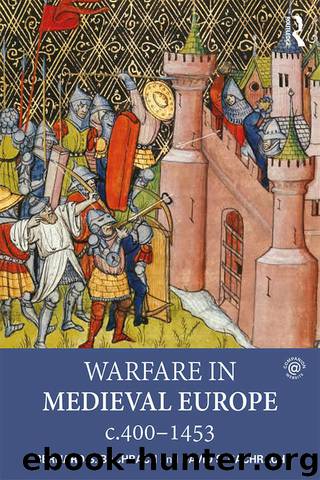
Author:Bernard S Bachrach & David Bachrach [Bachrach, Bernard S]
Language: eng
Format: azw
ISBN: 9781138887657
Publisher: Taylor and Francis
Published: 2016-10-03T16:00:00+00:00
Warfare and institutionalized taxation
Through much of the Middle Ages, centralized control over the conduct of war did not lead to the reestablishment of the types of broad-based taxation that financed the army and military infrastructure of the late Roman empire. Rulers such as Charlemagne and Otto the Great were able to raise large armies and carry out wars of conquest on a scale similar to the late Roman emperors without the need for substantial taxation. This was due to a number of factors including the replacement of direct taxation with personal military service by landowners and the concomitant requirement for militia troops, as well as magnates with military households, to pay for their own supplies. Another crucial factor, and one that is often not appreciated by scholars, is the enormous wealth of the powerful rulers of the Carolingian and German empires, which was derived from the assets of the royal fisc. In essence, they were able ‘to live off their own’ rather than seek revenues from their subjects.
The most important driver of increased governmental expenses during the later medieval period was warfare. However, the wars waged by the kings of France in the fourteenth and fifteenth century, for example, were smaller in an absolute sense than those waged by Charlemagne in the eighth and early ninth century. Even taking into account the substantial decline in population brought about by the arrival of the Black Death in 1347, it is clear that the armies operating during the Hundred Years’ War were relatively modest in size. The impetus for the renewal of institutionalized taxation, therefore, was not the scale of the military burdens of the government but rather the scarcity of economic resources under direct governmental control. Kings could no longer ‘live off their own’, much less wage war with the limited resources available from the fisc.
One of the early efforts to re-impose broad-based taxation, drawing upon both Carolingian and Ottonian, as well as Roman precedents, was undertaken by Frederick Barbarossa. However, he did not look to his German domains for taxes, but rather to northern Italy. In 1158, after his siege and capture of the fortress city of Milan, Barbarossa summoned both German and Italian magnates to an imperial assembly at Roncaglia, located near the city of Piacenza, with the goal of defining and laying claim to all imperial rights in Italy. Barbarossa called upon four legal scholars from the law school established at Bologna in 1088, to analyze all legal texts pertaining to taxation and other support that were owed to the imperial authority by the northern Italian cities. These legal scholars confirmed that the imperial government had the right to levy taxes amounting to some 30,000 pounds of silver per year in support of the emperor’s governance of the res publica, which included the waging of war. Ultimately, the emperor’s numerous opponents in Italy refused to accept the judgment of the jurists and assembly, and Barbarossa was only able to establish his claims to taxes when he had his army in situ.
Download
This site does not store any files on its server. We only index and link to content provided by other sites. Please contact the content providers to delete copyright contents if any and email us, we'll remove relevant links or contents immediately.
| Africa | Americas |
| Arctic & Antarctica | Asia |
| Australia & Oceania | Europe |
| Middle East | Russia |
| United States | World |
| Ancient Civilizations | Military |
| Historical Study & Educational Resources |
The Radium Girls by Kate Moore(12035)
100 Deadly Skills by Clint Emerson(4931)
Rise and Kill First by Ronen Bergman(4797)
The Templars by Dan Jones(4695)
The Doomsday Machine by Daniel Ellsberg(4493)
The Rape of Nanking by Iris Chang(4224)
Killing England by Bill O'Reilly(4008)
Stalin by Stephen Kotkin(3973)
Hitler in Los Angeles by Steven J. Ross(3949)
12 Strong by Doug Stanton(3554)
Hitler's Monsters by Eric Kurlander(3348)
Blood and Sand by Alex Von Tunzelmann(3207)
The Code Book by Simon Singh(3197)
Darkest Hour by Anthony McCarten(3135)
The Art of War Visualized by Jessica Hagy(3014)
Hitler's Flying Saucers: A Guide to German Flying Discs of the Second World War by Stevens Henry(2758)
Babylon's Ark by Lawrence Anthony(2685)
The Second World Wars by Victor Davis Hanson(2529)
Tobruk by Peter Fitzsimons(2521)
